“The country we carry in our heart is waiting.’” –Bruce Springsteen, New York Times, August 4, 2004
In the summer of 2004, Bruce Springsteen was all over the news.
Not for any of the usual reasons, though. It had been two years since his last album, and his follow-up was still more than a year away. His last tour was almost a year in the rear view mirror, and he hadn’t broken up or reunited his band lately.
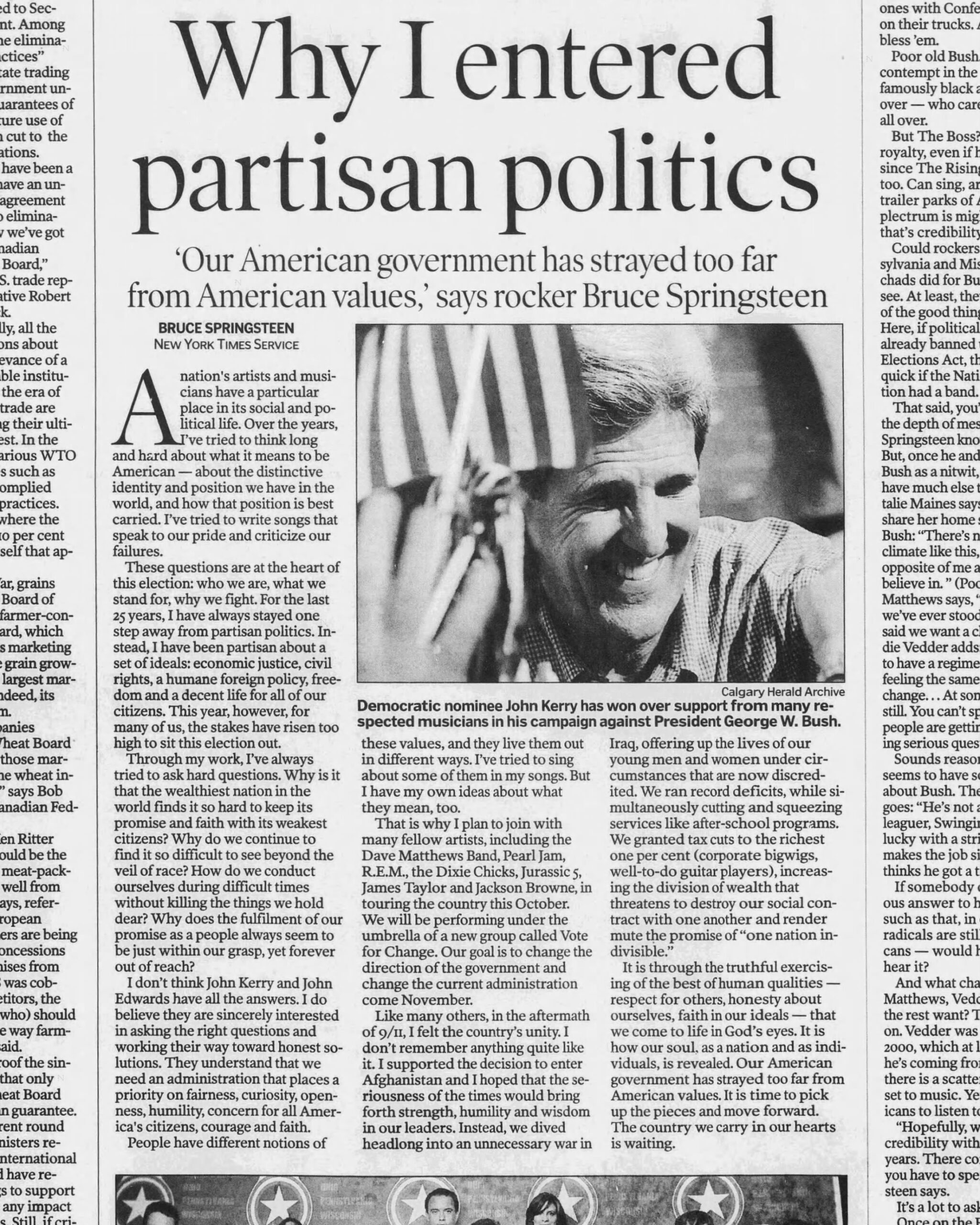
Springsteen was in the news because he had done something that shocked the nation: he endorsed a political candidate.
And by endorsed I mean a full-throated endorsement of presidential candidate Senator John Kerry in the form of a personally written, nationally syndicated New York Times editorial.
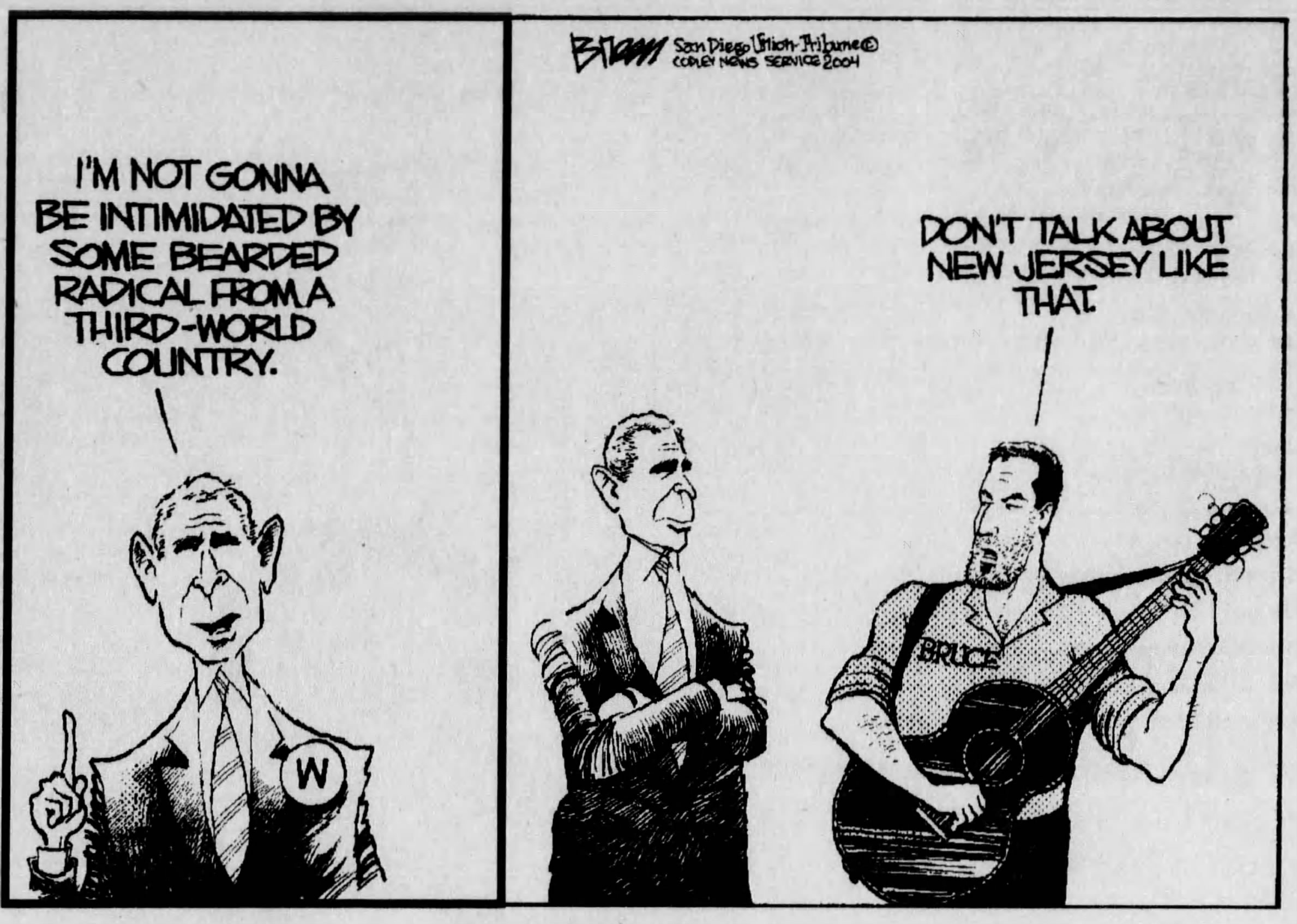
And if that wasn’t enough, in the same editorial he announced an all-star tour called Vote for Change with a mission to oust the Bush administration and usher in a new direction for the country.
Public reaction was immediate and vocal. “I refuse to take political advice from an Ocean County College dropout,” read one letter to the editor in the Asbury Park Press.
Other reactions were more thoughtful, if still critical: “I and a lot of other longtime fans are surprised and disappointed with Springsteen’s decision to play the Vote for Change concerts in October,” wrote another APP reader. “It’s not because he is supporting John Kerry. It’s because he is supporting a political candidate directly and allying himself with mainstream political machinery.”
Whether supportive or critical, the vast majority of mainstream and vocal fan reactions expressed surprise, and that second letter to the editor seemed to peg the reason.
After all, Springsteen had long been outspoken on social causes and civic controversies. Fifty-six years before “Streets of Minneapolis,” he wrote and performed a mournful elegy to the victims of the Kent State massacre called “Where Was Jesus in Ohio?”
He’d headlined the Musicians United for Safe Energy (MUSE) concerts in 1979…
…the Amnesty International Human Rights Now! Tour in 1988…
…and took action on his own to promote the nascent Vietnam Veterans of America in 1981 with a special benefit concert.
In 1990, Springsteen played a pair of acoustic shows benefitting the Christic Institute, a public interest law firm and activism organization.
And two years later, he turned a cable TV novelty song into a scathing condemnation of the police beating of Rodney King.
More recently, he’d generated controversy by writing a song about the 1999 murder of Amadou Diallo by police officers and performing it nightly following the acquittal of the officers responsible.
But somehow, through all of it, Springsteen managed to stay unassociated in the public eye with a particular political leaning, let alone a party or candidate, even though each of those causes were generally associated significantly more with progressive politics than conservative.
So when he finally took a public stand for a political candidate, it came as a surprise to almost everyone.
Technically, it wasn’t the first time he’d endorsed someone for president, although Springsteen didn’t have quite the public profile in 1972 when he lent his name and talents to the campaign of Democratic presidential candidate George McGovern.
It also wasn’t the first time he spoke out against the current office-holder. On the night after President Reagan’s election, Bruce famously remarked from the stage, “I don´t know what you guys think about what happened last night but I think it´s pretty frightening.”
Four years later, Reagan did his best to associate himself with the now mega-star Springsteen by rhetorical proximity.
Although he typically let such attempts pass by without comment, Bruce responded to Reagan from the stage two days later.
Both times, though, he was brief enough and sly enough that his remarks went mostly unnoticed.
This time was different. On stage during the Vote for Change Tour that fall, Bruce abandoned all pretense at subtlety, opening his shows with the “Star-Spangled Banner” and using “Mary’s Place” as a nightly set piece to galvanize his audience into action.
Springsteen did everything he could to help the Kerry-Edwards ticket, but as history records, everything he could do wasn’t enough.
President Bush won re-election, but Bruce continued to speak out against him, especially in the aftermath of Hurricane Katrina and the Bush administration’s tragic mismanagement of the relief effort.
When the next U.S. presidential campaign came around, Bruce didn’t wait until the fourth quarter to get in the game. On April 15th, 2008, he endorsed a candidate in the heat of primary season, and this time he bet on the winning horse.
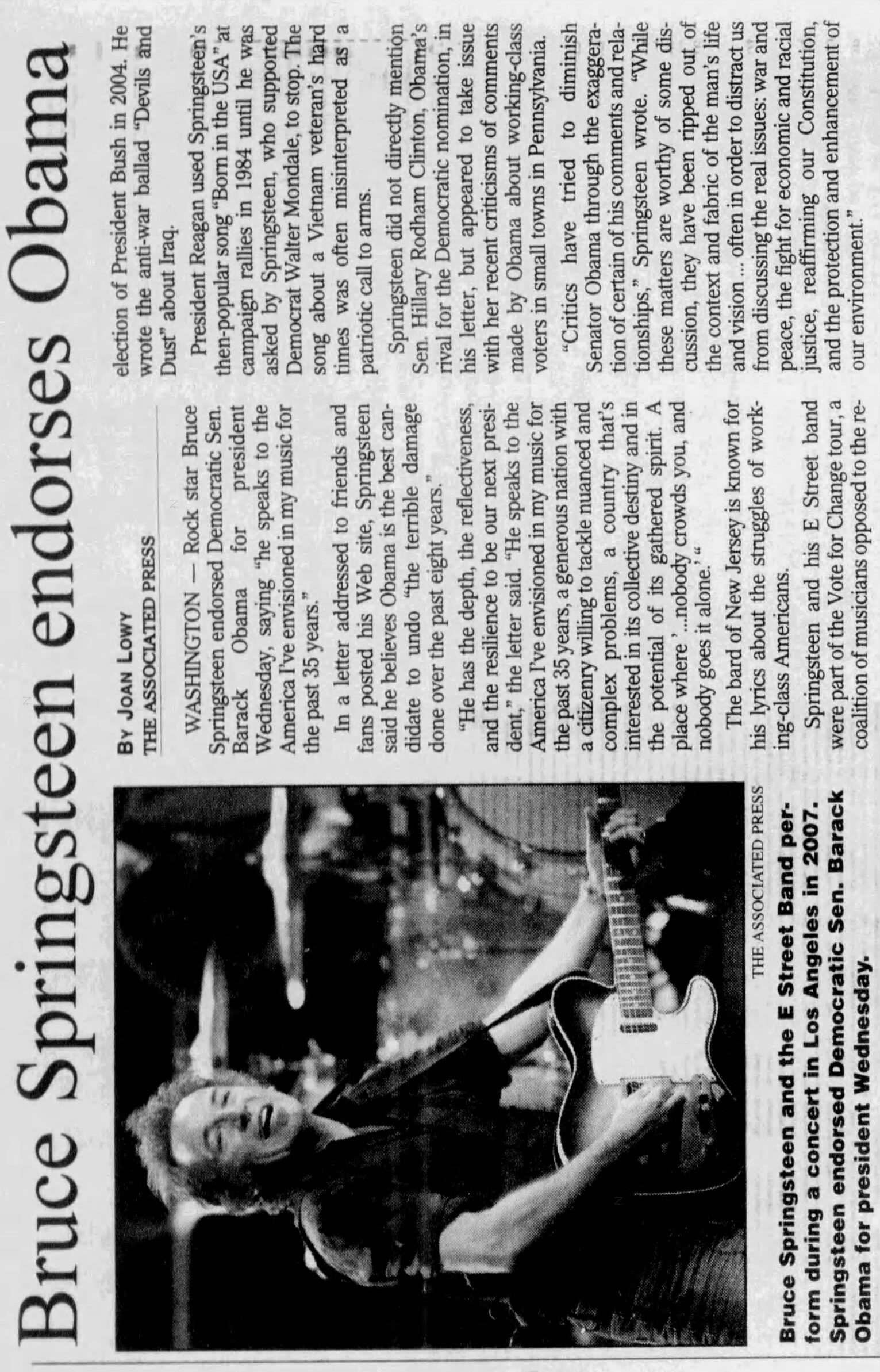
Bruce’s backed up his early endorsement of Senator Barack Obama with frequent road, rally, and fundraising appearances with the candidate, kick-starting a friendship that grew stronger over the years and endures to this day.
By the time Senator Obama became President Obama, Bruce had established himself as a key voice in the American civic discourse. It was no surprise when he was asked to perform at the inauguration, an appearance he reprised twelve years later by invitation from the Biden Inaugural Committee.
The songs he performed–”The Rising” in 2008 and “Land of Hope and Dreams” in 2020–had always been inspirational. Now they’d become iconic, the former representing the indefatigable American spirit and the latter symbolizing the American promise.
But those were America’s brighter years. In between Presidents Obama and Biden came the first Trump administration. The American resistance movement began immediately upon Trump’s inauguration, and Springsteen wasted no time aligning himself with it in his opening remarks in Perth the following day.
A week later, he spoke up on stage against Trump’s Muslim ban…
…and three days after that he declared himself an “embarrassed American” following Trump’s rude treatment of the Australian Prime Minister.
But those early days offered only a very small taste of what was to come when Trump returned to office in 2025. For many if not most, embarrassment gave way to horror as Trump began waging an all-out assault against the American social contract, its constitutionally guaranteed rights and liberties, and even the very notion of citizenship itself.
Retitling his ongoing world tour the Land of Home and Dreams Tour, Bruce spent much of 2025 ratcheting up his rhetoric overseas calling out the Trump administration back home. From the stage in Manchester, he spoke eloquently:
In my home, the America I love, the America I’ve written about that has been a beacon of hope and liberty for 250 years, is currently in the hands of a corrupt, incompetent, and treasonous administration.
In America, they are persecuting people for using their right to free speech and voicing their dissent. This is happening now.
In America, the richest men are taking satisfaction in abandoning the world’s poorest children to sickness and death. This is happening now.
In my country, they’re taking sadistic pleasure in the pain that they inflict on loyal American workers, they’re rolling back historic Civil Rights legislation that led to a more just and plural > society, they’re abandoning our great allies and siding with dictators against those struggling for their freedom.
They’re defunding American universities that won’t bow down to their ideological demands. They’re removing residents off American streets and, without due process of law, are deporting them to foreign > detention centers and prisons. This is all happening now.
A majority of our elected representatives have failed to protect the American people from the abuses of an unfit president and a rogue government.
They have no concern or idea of what it means to be deeply American. The America that I’ve sung to you about for 50 years is real, and regardless of its faults, is a great country with a great people.
After the tour ended, things got even worse.
As 2025 drew to a close, President Trump demolished the East Wing of the White House to build a ballroom no one needed and only he wanted, turning the seat of American democracy into a symbol of elitism and public disregard.
He renamed the Kennedy Center after himself, and then closed it when no one would perform there.
He started bombing boats in the Caribbean without proof or explanation of wrongdoing and killed the survivors.
He threatened Democratic members of Congress with prosecution for speaking out against him.
In the early days of 2026, he ordered the military to invade Venezuela.
He seized election ballots from Georgia.
He increased health insurance premiums for millions.
And then there was ICE.
For months, Trump sent masked, armed, untrained and unaccountable enforcers into American cities, capturing citizens and non-citizens alike, detaining and deporting them without due process or due diligence.
It all came to a head in Minneapolis, when in rapid succession Renee Good and Alex Pretti, two local and peaceful protesters , were executed by ICE officers in the street.
That was the final straw for Bruce Springsteen.
Just like the rest of the country, Bruce was aghast and horrified at the events playing out on our screens. He immediately wrote, released, and publicly performed a protest song called “Streets of Minneapolis,” but unbeknownst to us he was already working on much more.
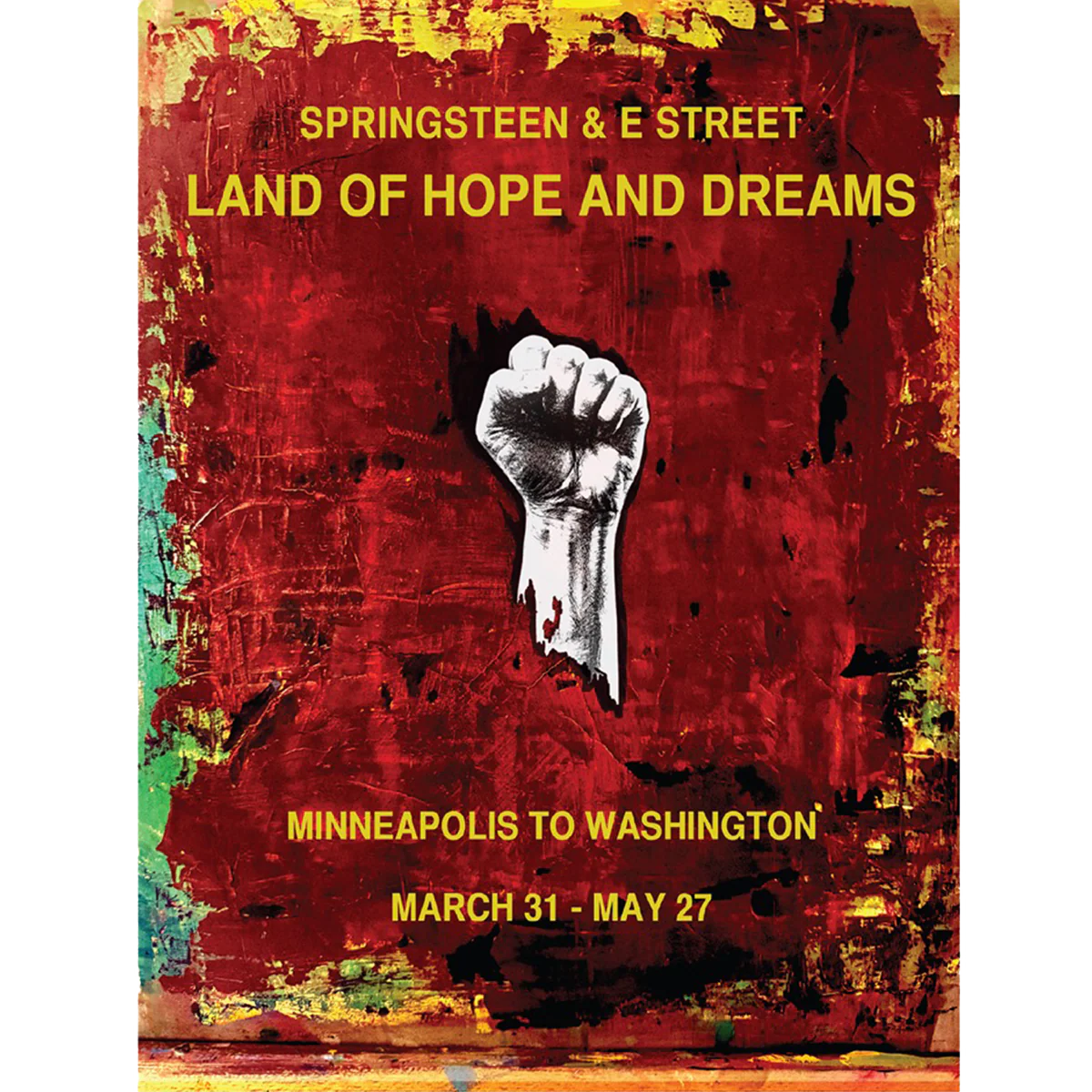
In mid-February, he surprised fans by announcing an imminent Land of Hope and Dreams American Tour, a tour he would admit on stage “was never supposed to happen.”
Bruce’s tours typically provide considerable lead time, but this one began six weeks after it was announced.
Even so, everything about the Land of Hope and Dreams Tour was deliberate, from the set list to the itinerary. The tour would begin in Minneapolis, which had become the symbolic center of the American resistance movement, and end in Washington, D.C. the current residence of the “wanna-be king.”
(An NBA post-season game would end up pre-empting the Philadelphia show, but even then Bruce was intentional in his response, moving the show so that the tour would now end in the birthplace of American democracy.)
Unlike the Land of Hope and Dreams European Tour in 2025, which wove plenty of crowd-pleasers and wild cards into a politically-themed setlist backbone, this time Bruce crafted a sharp, finely-honed American setlist that would remain virtually identical throughout the tour.
Like his Broadway show, almost every song in the Land of Hope and Dreams American Tour main set had a place and purpose (“Hungry Heart” and “Because the Night” are the inexplicable exceptions), and together they formed a narrative arc that began with a shout of anger before descending into grief, only to rise in resistance and end in hope and optimism.
It was arguably the most cohesive and powerful set list Bruce has ever created, and while some fans might have been disappointed at the lack of night-to-night variation, this fan thinks it was virtually perfect.
I was present for opening night in Minneapolis. Because I abandoned all social media a year or so back, I’d managed to avoid spoilers completely. For the first time this century, I walked into a Bruce Springsteen concert completely unaware of what was to come.
It was my 99th show, and without question it was and will likely remain my all-time favorite.
I hadn’t realized just how much I needed to be in a place where it was okay to be angry, okay to mourn, and okay to still have hope. I didn’t know how much I needed to feel supported in a sea of resistance and defiance.
I felt an electric current run through me at the unexpected “Born in the U.S.A.” at the top of the show. I wept at a majestic “American Skin (41 Shots).”
I laughed at the inclusion of “Out in the Street” and “Wrecking Ball,” both of which took on new meaning in this particular context.
And witnessing the E Street Band public premiere of “Streets of Minneapolis” performed for the people it was written for was a moment I’ll always remember.
Only one moment jolted me out of the show. I gaped in astonished disbelief at the tonally and totally inappropriate inclusion of “Hungry Heart,” a song that’s all about walking away from our commitments to each other, a song about the ties that don’t bind us. What the heck was Bruce thinking? I was certain he’d remove it from the set list after the first night. He never did.
When the main set drew to a close with “Land of Hope and Dreams,” I suspected I’d be disappointed with the encore. Bruce’s encores haven’t varied much in recent years–they tend to be the home of obligatory chestnuts and crowd-pleasers. And I’m actually okay with that… most of the time.
On this night, “Born to Run,” “Bobby Jean,” “Dancing in the Dark,” and “Tenth Avenue Freeze-Out” all left me cold. After the show we’d just seen, it felt like playing dress-up, like we were reliving past tours instead of celebrating this one. And where was “American Land”? How could he have left out that one? (Bruce read my mind and added it to the encores a week later, where it would remain for the rest of the tour.)
“Chimes of Freedom” brought me back into the moment, however, along with Bruce’s closing benediction–his most eloquent of the evening.
I know for me, the hardest part about all of this is feeling the distance between your neighbors, your fellow citizens, and that distance… well, it can darken your soul.
We have a leader who says he wishes nothing but ill upon the people he disagrees with and who disagree with him.
Well, I don’t feel that way.
America, from the beginning, was born out of disagreement, was built on disagreement. We can argue about what course we think the country should take while recognizing our common humanity, our > dignity, and yes, our unity.
Now, I go back to thinking about Renée Good’s last words before she died, to the man who she was protesting against, the man who would take her life. She said, “That’s fine, dude, I’m not mad at you. I’m not mad.” God bless her.
So tonight, when you go home, hold your loved ones close. And tomorrow, do as Renée did, find a way to take aggressive, peaceful action to defend our country’s ideals.
And as the great civil rights leader John Lewis said, “Go out and get into some good trouble.” Say something! Do something! Hell… sing something!
If you’re feeling helpless, hopeless, betrayed, frustrated, angry… I know I’ve been. That’s why The E Street Band is here tonight. This is a tour that was not planned. We’re here tonight because we > need to feel your hope, and your strength. And we want to bring some hope and some strength for you. I hope we did that.
All I can say is God bless Alex Pretti, God bless Renée Good, God bless you, and God bless America.
He closed the show with a one-off surprise performance of “Purple Rain,” a special thank-you gift for the people of Minneapolis for lighting the way for the rest of us.. It was beautiful and heart-breaking and essentially the city’s anthem, and because of that I can forgive him ending the show with a song about a world-ending apocalypse. (Sometimes I hate my analytical brain.)
The following show in Portland was my 100th show. It will probably end up being my last. The crowd was even more energetic than on opening night, and I can’t imagine enjoying future shows as much as I enjoyed these two.
I can’t imagine needing a show as much as I needed these two.
But if there’s one thing I know to be true at this point in history, it’s that the future is unpredictable. And if there’s another, it’s that as long as Bruce Springsteen is alive and kicking, he’ll rise to whatever moment the future brings.
© May 23, 2026