“Tomorrow, do as Renée did. Find a way to take aggressive, peaceful action to defend our country’s ideals… Say something! Do something! Hell.. sing something! ” –Bruce Springsteen, March 31, 2026
What would the famously fastidious Bruce Springsteen say if we told him in 1975 it would take another fifty years to notch his first Number One hit, and that it would be a song that topped the charts only ten days after the events that inspired it?
Any irony or disappointment would probably be outweighed by appall over the circumstances that inspired future Bruce to write “Streets of Minneapolis.”
The song was born out of the chaos of Operation Metro Surge. In early 2026, the United States Department of Homeland Security sent more than three thousand Immigration and Customs Enforcement (ICE) agents into the Twin Cities.
Ostensibly targeting allegations of fraud perpetuated by the cities’ Somalian community, it quickly became clear that the agents were indiscriminately arresting local residents without due diligence, care, or compassion.
Thousands of non-citizens and citizens alike were swept up by ICE agents, whose bravado and cruelty accelerated by equal measure. Less than one in four arrestees had a criminal record, and more than a third were caught up in collateral sweeps rather than targeted raids.
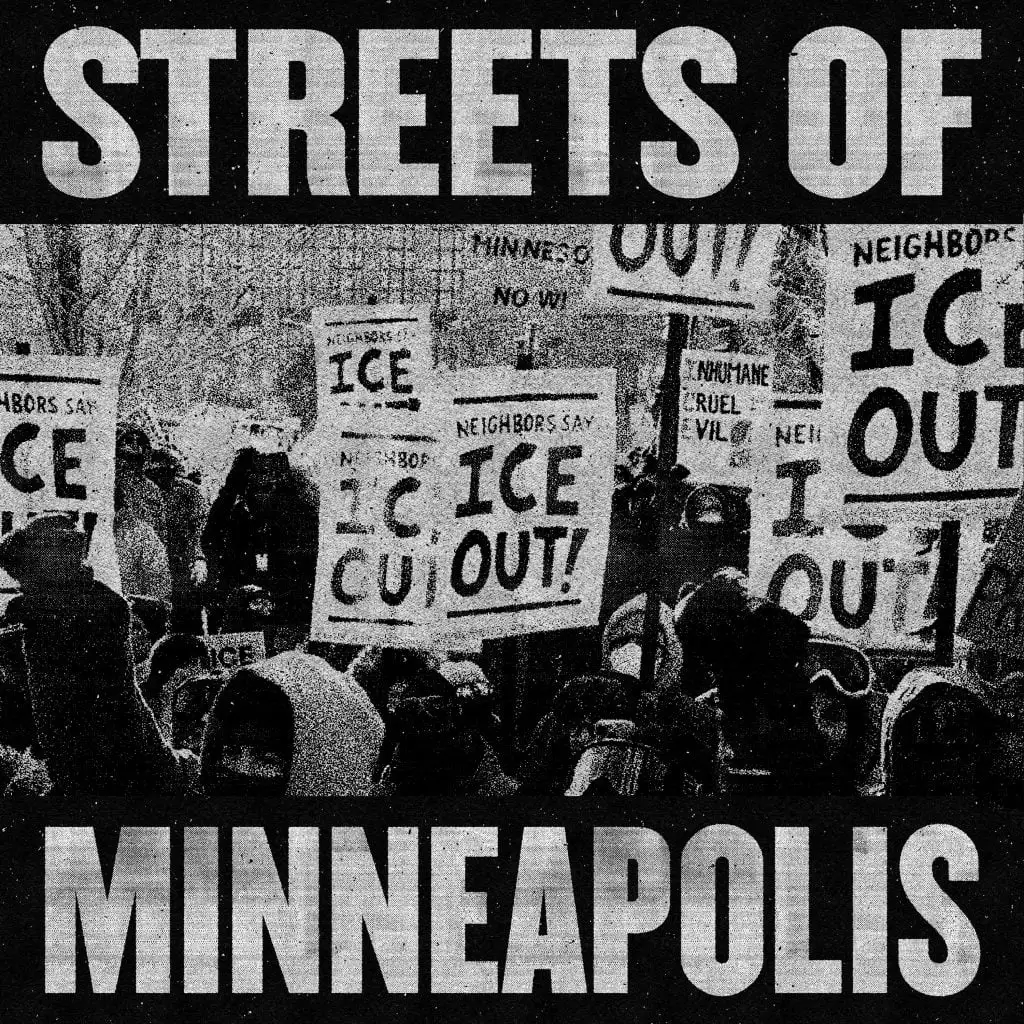
In response, thousands of Minnesotans took to the streets to act as scouts, observers, protectors, documentarians, and agents of public conscience.
They were astonishingly successful. Each night, the evening news featured stories of raids and arrests foiled by the actions of concerned neighbors. Even though most took great care to observe the law and rely on their constitutional rights of free speech and protest, ICE began resorting to acts of verbal and physical intimidation to dissuade them.
Americans watching the drama play out nightly on television felt a foreboding sense of a cauldron about to boil over–which finally happened on January 7th when local resident Renée Good was murdered by an ICE agent who shot her repeatedly as she respectfully disengaged and drove away from the scene.
Although Trump administration officials (including the president and vice president) did their best to paint Good as a violent threat to the shooter, video evidence continued to emerge over the following days and weeks that proved otherwsie.
Still reeling from the shock of witnessing their own government murder an innocent citizen, Americans watched in horror seventeen days later as a VA intensive care nurse named Alex Pretti was murdered while first observing and then helping a woman being arrested by CBP agents.
Once again, the Trump administration tried to label a good samaritan as an agitator and insurrectionist. And once again, the video evidence and eyewitness reports proved otherwise.
What little public support remained for the mass deportations quickly began to evaporate, and public outrage erupted in the form of nationwide protests.
Alex Pretti was killed on Saturday, January 24, 2026. Bruce Springsteen wrote “Streets of Minneapolis” that same day.
He recorded it three days later and released it on Wednesday, January 28th–a land speed record for an artist known for being somewhat obsessive about his craft.
And let’s be honest: it shows.
“Streets of Minneapolis” is far from Bruce’s best work. The rhymes are often lazy, the meter is occasionally clumsy, and the melody is… let’s call it an homage to local hero Bob Dylan.
As Springsteen protest songs go, it’s nowhere near as artful or nuanced as “American Skin (41 Shots)” or “Born in the U.S.A.”
But that’s okay. As Tom Morello reportedly explained to Bruce, “Nuance is wonderful, but sometimes you have to kick them in the teeth.”
There’s a certain weight that comes with a Bruce Springsteen protest song. It’s never about the melody, and it’s only partially about the lyrics. It’s about giving voice to those no longer able to speak for themselves. It’s about expressing the outrage we don’t know how to articulate ourselves. It’s about the dirt, the blood, and the names we aren’t supposed to forget. It’s about galvanizing us into action.
There are songs that make you think, and there are songs that make you feel. And on rare occasion, a song like “Streets of Minneapolis” comes along… a song that makes you act.
When “Streets of Minneapolis” dropped that late January day, it didn’t feel like a polished studio single. It felt like an emergency broadcast.
Radio stations, news outlets, fans and pundits all picked up the signal and relayed it onward. By the end of the day, it had amassed 2.5 million views on YouTube alone. Bruce quickly followed up with a more polished mix, a more radio-friendly edit, and a video.
Within two weeks, according to Little Steven in an E Street Radio interview, “Streets of Minneapolis” generated over one billion hits worldwide, by far Springsteen’s most popular song.
The song touched a nerve in all who heard it. Perhaps there’s a lesson: sometimes you have to drop all attempts at metaphor, subtlety or universality to break through and capture the public consciousness. (I’m sure that many listeners moved to protest by “Streets of Minneapolis” are still unaware of what “Born in the U.S.A.” is about.)
And that’s not to say there’s no art here.
Through the winter’s ice and cold, down Nicollet Avenue
A city aflame fought fire and ice ‘neath an occupier’s boots
King Trump’s private army from the DHS, guns belted to their coats
Came to Minneapolis to enforce the law or so their story goes
“A city aflame fought fire and ice” is a nice play on the dual meaning of ice in this song (although it would have been better if he hadn’t already used “ice” in the previous line).
Against smoke and rubber bullets, in the dawn’s early light
Citizens stood for justice, their voices ringing through the night
And there were bloody footprints where mercy should have stood
And two dead left to die on snow-filled streets, Alex Pretti and Renee Good
“The dawn’s early light” is a reference to “The Star-Spangled Banner” of course, which means the “smoke and rubber bullets” is meant as a comparison to the battle of Fort McHenry. Which in turn means that Bruce is equating citizen protesters and defenders to the American flag itself–an essential symbol of the United States. That couplet is the song’s most beautiful and powerful passage,
The weakest is the chorus:
Oh our Minneapolis, I hear your voice singing through the bloody mist
We’ll take our stand for this land and the stranger in our midst
Here in our home they killed and roamed in the winter of ’26
We’ll remember the names of those who died on the streets of Minneapolis
I can’t help but suspect the entire chorus is built around answering the question: What rhymes (ish) with Minneapolis? But again, it’s a quibble. Minneapolis deserves to be celebrated, and it’s a hard word to rhyme.
Trump’s federal thugs beat up on his face and his chest
Then we heard the gunshots and Alex Pretti lay in the snow dead
Their claim was self-defense, sir, just don’t believe your eyes
It’s our blood and bones and these whistles and phones against Miller and Noem’s dirty lies
Now they say they’re here to uphold the law but they trample on our rights
If your skin is black or brown my friend you can be questioned or deported on sight
In our chants of “ICE out now!” our city’s heart and soul persists
Through broken glass and bloody tears on the streets of Minneapolis
We’re so used to hearing Bruce’s condemnation voiced through fictional characters that it’s jarring to hear him sing the names of Donald Trump, Stephen Miller, and Kristi Noem. Even “American Skin (41 Shots)” fictionalized its characters, with only the title parenthetical making clear the author’s inspiration.
“Streets of Minneapolis” serves as a grim ledger of names we might otherwise let slip through the cracks of the news cycle and history.
Like the repeated references to “the winter of ’26,” Bruce anchors his song to a specific events at a particular point in time, ensuring that even decades hence, no one will ever wonder what “Streets of Minneapolis” is about.
Six days after he wrote it, three days after he recorded it, two days after he released it: Bruce Springsteen performed “Streets of Minneapolis” live on stage for the citizens he wrote it for, as a special guest at Tom Morello’s First Avenue benefit show.
He performed it again for an even bigger crowd at the flagship No Kings Day rally at the Minnesota State Capitol.
But even the hardcore fans who watched both performances live or online couldn’t have been prepared for the power of “Street of Minneapolis” when arranged for and performed by the full E Street Band.
That first full-band performance helped kick off the opening night of a tour that was never supposed to happen, sparked by a horrific murder that never should have happened, and a heroic response that only could have happened in Minneapolis.
Springsteen never had any doubts about where the impromptu tour would open: it could only be Minneapolis. Before a sold-out crowd craving catharsis, he saluted “the power and solidarity of the people of Minneapolis… an inspiration to the entire country.”
“Your strength and your commitment told us this is still America. And this will not stand.”
Streets of Minneapolis
Recorded: January 27, 2026
Released: Streets of Minneapolis (single, 2026)
First performed: January 30, 2026 (Minneapolis, MN)
Last performed: May 30, 2026 (Philadelphia, PA)
© April 28, 2026