Amadou Diallo was a citizen of the world, but he dreamed of the United States of America.
Born to Guinean parents living in Liberia, he spent his early childhood in Togo and Guinea and went to high school in Thailand. When the dot-com era exploded, Amadou enrolled in a Cambridge University-sponsored IT program in Singapore.
By the time he graduated, Amadou was fluent in English, French, Spanish, and Thai. He knew that education was the key to a good life, and he was determined to go to college in America.
His family urged him not to. It wasn’t safe, they said. Too many Guinean families had lost too many sons to street shootings in American cities.
But Amadou was determined. He was a fan of an American musician named Bruce Springsteen, who sang about ordinary people who dreamed of a better life and worked hard to find one. He played “Born in the U.S.A.” over and over, the chorus luring him like a beacon.
In September 1996, at the age of twenty-one, Amadou took the leap and moved to New York City to pursue his dream of a computer science degree from an American university.
He left a two-line note for his mother: “The solution is U.S.A. Don’t leave my brothers and sister here.”
Amadou had a cousin living in the U.S. who found him a roommate and a place to live. The only problem was Amadou had no money for rent, let alone school. So he set up a cart on East 14th Street and sold hats gloves, music, and other items for up to twelve hours a day, six or seven days a week.
By January 1999, Amadou had saved up enough money to realize his dream.
He called his mother, still living in Guinea, on January 31st and told her, “I’m so happy right now, Mom! I am going to do it.”
Do what, she asked.
“Enroll in college!”
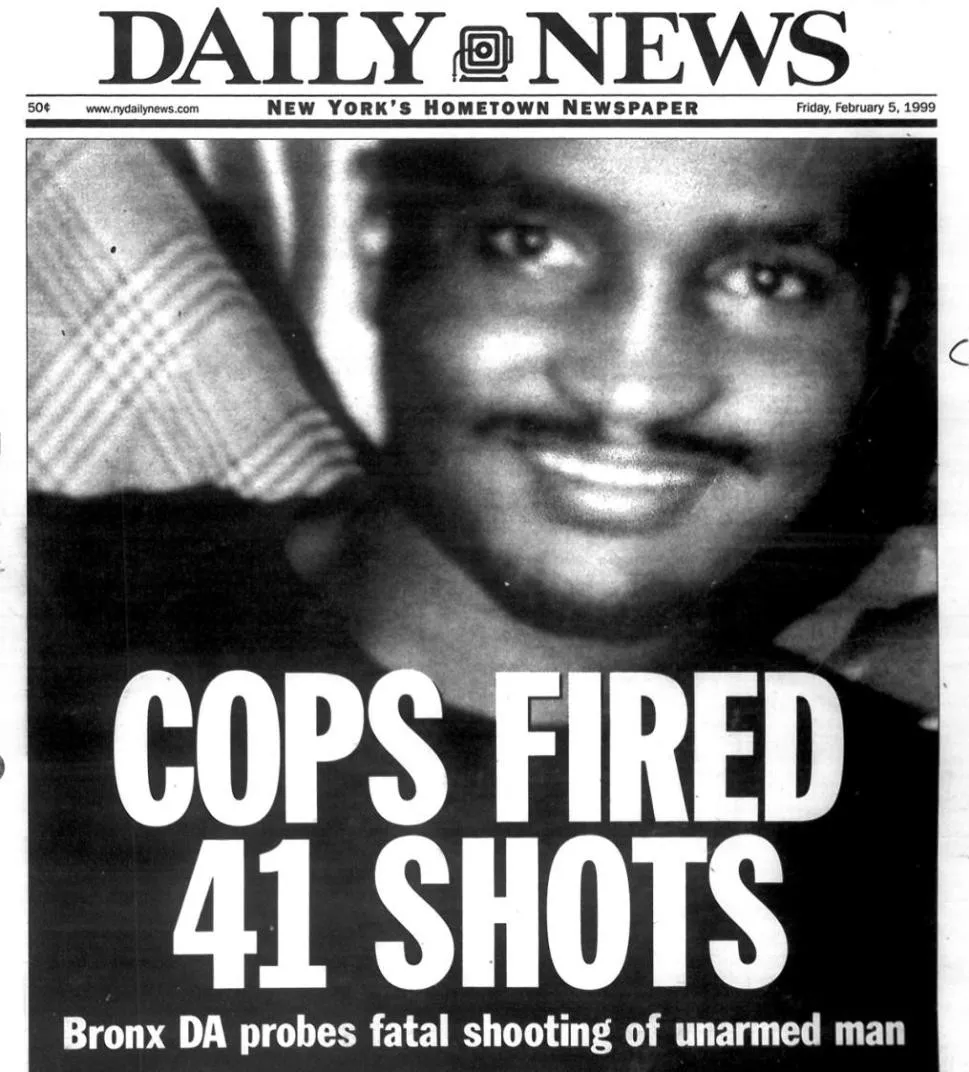
Four days later, Amadou returned home from a late dinner after a long day at work. Sometime after midnight, four New York City police officers in an unmarked car saw him standing at the entrance to his building looking up and down the street.
In later testimony, one of the officers stated they thought Diallo was a serial rapist who had eluded arrest for six years. The officers–none of whom were in uniform–approached Diallo, who backed up into the building’s vestibule.
One officer shouted, “Police! Show me your hands!” while another shouted, “Don’t move!”
Confused and frightened, Amadou–who had a life-long stammer that became especially pronounced when frightened–reached into his pocket to retrieve his wallet and identification. One of the police officers panicked, assuming Diallo was reaching for a gun, and fired his weapon.
The officer fell backwards from the recoil of the gun, but the other three officers believed he fell because he had been shot by Diallo. All four officers fired upon the unarmed man, who quickly fell to the ground.
The officers kept shooting.
By the time they stopped, Amadou had been shot once in his back, once in his chest, once in his right arm, five times in his left torso, five times in his right leg, and six times in his left leg.
Forty-one shots found their target nineteen times.
Amadou Diallo died that night, February 4 1999, at the age of twenty-three.
Although Diallo was clearly innocent and unarmed, the NYPD internal investigation cleared the officers of wrongdoing. Nevertheless, a grand jury indicted all four officers on charges of second degree murder and reckless endangerment.
On February 25, 2000, a jury acquitted the officers of all charges. The case became a national story, sparking protests, calls for federal action, and national conversations about racial profiling, officer training, and police brutality.
In March, the United States Department of Justice found that the NYPD had engaged in racial profiling.
In April, Amadou’s parents filed a $61 million lawsuit against the city and the officers, accusing them of racial profiling and wrongful death.
And on April 22, Bruce Springsteen and the E Street Band started rehearsing a new song.
They debuted it six weeks later on June 4th in Atlanta. Springsteen introduced it simply: “This is a new song called ‘American Skin (41 Shots)’.”
That first performance was a bit rough. The arrangement hadn’t quite gelled, and the band sounds noticeably unsure about their parts. And although the title and lyrics made the song’s inspiration clear, fans familiar with the case might have scratched their heads at the way Bruce de-aged Amadou and changed his name to “Charles” (and his mother’s from Kadiatou to “Lena”).
Nevertheless, it was a remarkably raw and powerful performance, and word of the song quickly began to spread on the nascent online Springsteen community. Within days, it was picked up by mainstream media outlets.
If Kadiatou Diallo minded Bruce’s artistic liberties, she didn’t voice it. She called the song “a beautiful thought.”
Amadou’s father seconded his wife’s sentiment. “I appreciate anybody who calls Amadou’s name,” he told the New York Daily News, “anything that people do to keep his memory alive.”
Asked for comment, New York City Mayor Rudy Giuliani was initially noncommittal. Caveating that he hadn’t yet heard the song, he told the Daily News, “Unfortunately, a lot of people have exploited this case. I don’t know that that’s the situation here.”
That interview, published June 9th, also featured the first printed full lyrics to “American Skin (41 Shots),” which brought the song even wider attention.
41 shots, and we’ll take that ride
‘Cross the bloody river to the other side
41 shots, cut through the night
You’re kneeling over his body in the vestibule
Praying for his life
Is it a gun?
Is it a knife?
Is it a wallet?
This is your life
It ain’t no secret
It ain’t no secret
No secret my friend
You can get killed just for living in your American skin
41 shots, Lena gets her son ready for school
She says, “On these streets, Charles
You’ve got to understand the rules
If an officer stops you, promise me you’ll always be polite
And that you’ll never ever run away
Promise Mama you’ll keep your hands in sight”
Is it a gun?
Is it a knife?
Is it in your heart?
Is it in your eyes?
It ain’t no secret
41 shots, and we’ll take that ride
‘Cross this bloody river to the other side
41 shots, I got my boots caked with this mud
We’re baptized in these waters
And in each other’s blood
Those who listened or read closely realized Bruce had written a deeply nuanced song that conveyed empathy for both Diallo and the officers. In fact, the entire first verse is presented through the eyes and voice of the officers, horrified by the realization of what they’d done and praying for the boy’s survival.
The brilliance of Bruce’s chorus is how it works from both perspectives:
For the officers, it’s a daily life-or-death assessment they’re forced to make when a suspect reaches into their clothing. Is it a gun? Is it a knife? What if it’s only a wallet? What if it isn’t?
For Amadou/Charles and his mother, it’s a test that shouldn’t be forced upon them but is still the reality of their lives: Is it a gun? Is it a knife? Would you even be asking these questions if I was white?
Lena’s instruction to her son (“Promise me if an officer stops you, you’ll always be polite / And that you’ll never ever run away / Promise me you’ll keep your hands in sight.”) is a survival ritual that defines the American experience for some but is invisible to others.
Even the final line: you can get killed just for living in your American skin. It works from both perspectives. An officer’s uniform–even just a badge–can make them feel just as vulnerable as powerful. Is he reaching for a gun or a wallet? I have to make a split-second judgment, because I might die if I’m wrong.
Bruce sums it up in a single couple in the third chorus: Is it in your heart? Is it in your eyes?
Where do your actions come from, he asks. Is it what your eyes show you? Or is it what fear has taught you? In Songs, Bruce summed it up this way: “Here is what systemic racial injustice, fear, and paranoia do to our children, our loved ones, ourselves. Here is the price in blood.”
“American Skin (41 Shots)” is a powerful piece of writing. Through careful crafting, Springsteen created a song of personal and societal grief. I have no doubt that most who heard that first performance in Atlanta realized it instinctively.
Even the music is mournful, masterpiece of restraint built on a hypnotic, mid-tempo groove. It feels like a long walk down a dark street—deliberate, steady, and slightly ominous. Max Weinberg’s drumming provides a heartbeat that refuses to speed up even as the tension rises, and Danny Federici’s organ swells create a thick, atmospheric fog.
But unfortunately, newsprint couldn’t capture the music, only the lyrics. And up north in New York City, emotions were still raw, especially among the ranks of the NYPD, who were feeling the strain of public sentiment turned against them.
It had only been a week since Bruce debuted his new song, and he’d been off the road ever since. But his next show was going to be the opening night of a ten-night stand at Madison Square Garden, and New Yorkers were wondering: will he play it here?
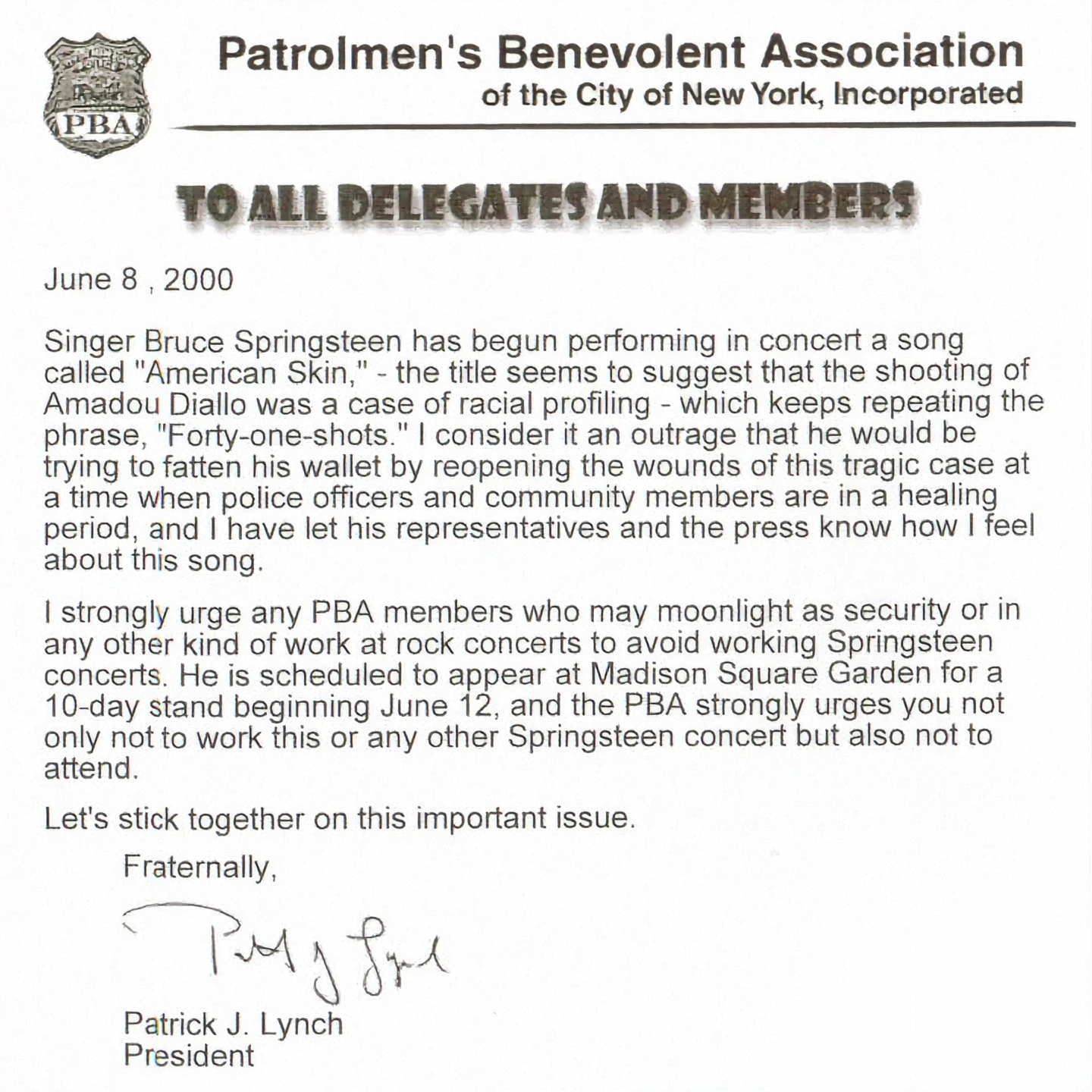
Springsteen had no comment, and the NYPD wasn’t going to wait for one. The New York City chapter of the Patrolmen’s Benevolent Association asked its members to boycott the entire stand, both on duty and off.
“Mr. Springsteen should remember that a jury with four African-Americans serving on it decided that the incident was a mistake, not a crime,” read the press release. “It’s unthinkable that a performer as prominent as Mr. Springsteen would decide that now is the time to reopen the wounds of the Diallo tragedy, while we are all striving for a period of healing.”
Bob Lucente, president of the New York Fraternal Order of Police, was less restrained in an interview with Brian Hiatt for SonicNet. “[Springsteen] has turned into some fucking dirtbag. He has all these good songs and everything, American flag songs and all that stuff, and now he’s a floating fag.”
That quote went viral around the same time that the first bootlegged version of “American Skin (41 Shots)” did as well.
Bruce stayed silent to the press, but he invited Diallo’s parents to attend the first night at the Garden. In a backstage meeting, the Diallos thanked Bruce for keeping their son’s memory alive, to which he replied: “I did what I could do.”
Bruce Springsteen and the E Street Band played “American Skin (41 Shots)” that night and every other night of the closing stand of their Reunion Tour. They’d slowed down the song a bit since Atlanta, letting it breathe more. Bruce’s vocals were more vulnerable, and Clarence Clemons now had a mournful saxophone solo to usher the song to a burial-like close.
And yes, there were some boos. Some officers or sympathizers declined to boycott but nevertheless flashed a badge, turned their backs, or gave Bruce the finger. A few rushed the stage before being removed by security.
Not all officers were offended, however. Lieutenant Eric Adams, for example, called Springsteen “courageous in the position he is taking.”
In his autobiography, Bruce wrote that when the song ended that first night at MSG, “you could feel the audience in the Garden breathe a sigh of relief. The world had not ended. Many of those who booed us cheered the rest of the show, but the cleaving scar of this one song, more than any other I’d written, stayed with us for a long time.”
Even three years later, when Bruce and the band played “American Skin (41 Shots)” on the last night of the Rising Tour, their police detail refused to usher them out of the stadium after the show.
Bruce debuted several new songs towards the end of the Reunion To, most of which wouldn’t see an official studio release for years to come. “American Skin (41 Shots)” was one of them, but at least it got an official live release in 2001 on Live in New York City.
Springsteen released five new albums over the next ten years, but none of them included “American Skin (41 Shots). Fans moved on, assuming the live release was all we were going to get.
In the meantime, the song continued to make appearances in every E Street Band tour except for Magic. Most notably, Bruce placed it into rotation on the Wrecking Ball Tour following the murder of Trayvon Martin in a case that rhymed with Diallo’s, and again in 2016 following the killing of Freddie Gray.
By then, Bruce had finally released a studio version, on his 2014 High Hopes album.
It was worth the wait. Bruce invited legendary guitarist Tom Morello into the studio with him (Morello was touring with the E Street Band at the time), and Morello’s pair of exquisite guitar solos elevated the song to new emotional, cathartic heights. For those who believe Springsteen’s studio recordings can’t hold a candle to his live performances, this new version proved a welcome exception.
When Morello continued on with the band for the High Hopes Tour, “American Skin (41 Shots)” became a nightly highlight, stretching to almost ten minutes in length.
When George Floyd was murdered by police at the height of the great pandemic, live performances weren’t possible. So Bruce took to the airwaves, opening his From My Home to Yours radio show with the studio version of “American Skin (41 Shots)” and following it with some pointed commentary:
Eight minutes. That song is almost eight minutes long. And that’s how long it took George Floyd to die, with a Minneapolis officer’s knee buried into his neck. That’s a long time. That’s how long he begged for help, and said he couldn’t breathe. The arresting officer’s response was nothing but silence and weight. Then he had no pulse, and still it went on… As of today, our black citizens continue to be killed unnecessarily by our police, on the streets of America.
It was still on Bruce’s mind at the tail end of the pandemic, so he added “American Skin (41 Shots)” to his reworked Broadway setlist as well.
It’s now 2026, more than a quarter-century after Bruce wrote a song that at the time felt instantly fixed in time and place.
Sadly, “American Skin (41 Shots)” remains as relevant as ever. America has regressed with a vengeance, with citizens and non-citizens alike swept of the street, deported, or killed based (in large part) on the color of their skin.
As of this writing, it serves as an mid-set highlight of the Land of Hope and Dreams American Tour, once more lifted by the contributions of Tom Morello.
It’s one of the few songs in Bruce’s catalog that moves me to tears every time I hear it. Every single time. Both from its message and the sheer tragic beauty of the song. I’m not sure I would ever call it the finest song he ever wrote (although it would always be in my top five), but it’s without question the most powerful.
I hope we live to see the day when it can be retired.
**American Skin (41 Shots)**Recorded: 2013
Released: High Hopes (2014)
First performed: June 4, 2000 (Atlanta, GA)
Last performed: May 30, 2026 (Philadelphia, PA)
© May 2, 2026
The Amadou Diallo Foundation advocates for racial equity and promotes education, particularly for students of African descent. You can sponsor or mentor a Diallo scholar, or volunteer your skills at https://amadoudiallofoundation.org/get-involved.html