The Land of Hope and Dreams American Tour followed a narrative arc from start to finish.
Over the course of three hours, Bruce Springsteen took us on an emotional journey that began with righteous anger, descended into grief, rose to resilience, and culminated with hope and optimism.
Springsteen had no shortage of songs to fill all four buckets, but only one could gracefully serve as the set’s centerpiece.
“My City of Ruins” holds anger and grief in one hand and resilience and hope in the other, taking audiences through the show’s full emotional journey in a single song.
Watch and see:
The city in “My City of Ruins” is a metaphor for the death of the American experiment, the American dream, and the American ideal. Its lyrics paint a grim scene of a post-apocalyptic country deserted by its defenders and turned against its own citizens.
There’s a blood red circle on the cold dark ground
And the rain is falling down
The church door’s thrown open, I can hear the organ’s song
But the congregation’s gone
My city of ruins
Now the sweet bells of mercy drift through the evening trees
Young men on the corner like scattered leaves
The boarded up windows, the empty streets
While my brother’s down on his knees
My city of ruins
There’s blood on the street, spilled during a winter of raids, detentions, deportations and murders. No one defends or protects the citizens forced to their knees by an unaccountable gestapo.
The federal government wraps itself in religion, abandoning any pretense of church and state separation, yet rejects the very ideals that Jesus preached.
The houses reflect the economic devastation spreading throughout the land.
Now there’s tears on the pillow, darling, where we slept
And you took my heart when you left
Without your sweet kiss my soul is lost, my friend
Tell me how do I begin again
My city’s in ruins
There’s a lover in the song, too. She represents liberty, freedom, and the social contract at the heart of America’s foundation. She’s gone now. We took for granted that she’d always be here, and we despair at her loss. How do we move on from here?
The answer: by digging in and rebuilding.
Now with these hands, with these hands
With these hands, with these hands
I pray, Lord
I pray for the strength, Lord
I pray for the faith, Lord
I pray for your love, Lord
Come on rise up
Rebuilding is hard, manual work. We ask God for the strength to do it, and for the faith and love to sustain us when the finish line seems so very far away.
But ultimately, it’s up to us to rebuild. And we start by standing up.
Bruce wrote “My City of Ruins” as a gospel song, very obviously modeled after Curtis Mayfield’s “People Get Ready.” (Mayfield’s melody threads throughout Bruce’s live arrangement.)
The E Street Choir lends their powerful voices to the final chorus, reminding us that we’re not alone, and that strength lies not in just in number but in unity. By the end of the song, we’ve shed our grief though shared catharsis and are ready to do the hard work.
“My City of Ruins” is a gorgeous and powerful song, obviously written explicitly for the moment that we’re in.
Except, of course, it wasn’t.
Like much of Springsteen’s catalog, “My City of Ruins” was originally written about something else altogether, but thanks to the nuance and imagery of Bruce’s songwriting he was able to repurpose it for a completely new context.
Fourteen years earlier, the metaphorical city was far more personal than political.
It was 2012, and Bruce was on tour with a very different E Street Band than the one fans were used to seeing. There were some new faces, but there were also a couple of very big absences.
We’d moved on from the loss of Danny Federici a few years earlier. He was an integral part of the E Street sound, but Charlie Giordano proved a more than able successor, and Danny had rarely been the focus of attention on stage.
But Clarence Clemons… his loss was something altogether different. His solos defined songs like “Jungleland,” “Drive All Night,” and “Bobby Jean,” and his presence… his presence on stage had always been essential. Elemental. His chemistry with Bruce was a key component of the E Street experience, and as the first tour without him neared, no one knew quite how to emotionally prepare for the show, much less embrace it.
Bruce knew that. He knew he had to thread a narrow needle: acknowledge, celebrate, and even preserve The Big Man as an eternal member of the band while allowing fans to grieve and move forward.
He accomplished all of it, in part by introducing Clarence’s nephew into a new E Street Horn section that would allow a relatively young Jake to step gradually into his uncle’s very large shoes, and in part by allowing his audiences to feel Clarence’s presence during “My City of Ruins.”
It was the perfect song for the moment, because the city in “My City of Ruins” is a metaphor for E Street Nation: the community, the brotherhood and sisterhood that unites us all at a Springsteen concert.
The lyrics of “My City of Ruins” acknowledge the emotional devastation of a great personal and loss. The church represents the empty concert arena, and the missing congregation is us, between tours, wondering if we’ll ever feel that magic again.
And that last verse… it broke our hearts to hear Bruce sing it, knowing how important their friendship was to him. Without your sweet kiss my soul is lost again is the line that shreds me. It refers, of course, to the “soul kisses” Bruce and Clarence often shared together during “Thunder Road” back in the day.
It was obvious to all in the arena that “My City of Ruins” was written for this moment, when we lost a beloved member of our favorite band, and we needed to move forward secure in the faith that he would always be with us.
Except, of course, it wasn’t about that at all.
In actuality, “My City of Ruins” was originally meant far more literally. Bruce wrote it for the city of New Orleans, following the devastation wreaked upon it by Hurricane Katrina and the failure of the Bush administration.
He performed it for the city in 2006 with the Sessions Band, and he continued to play it frequently throughout the tour.
Except, of course, it isn’t about that at all.
While Bruce did write the song about a literal city, it wasn’t New Orleans. Or for Christchurch, New Zealand or L’Aquila, Italy, even though he played it for both following destructive earthquakes.
No, he actually wrote “My City of Ruins” for New York City, following the terror attacks of September 11, 2001 that changed life in America forever.
That’s why we’ll find the studio version on The Rising, where it closes the album on a note of resilience and determination.
The Rising didn’t reach our ears until almost a year after the attacks, with the exception of “My City of Ruins.” Most of us first heard that one not even three weeks after 9/11, when Bruce helped a grieving nation pick themselves up in one of his most moving and memorable performances ever. Clearly he must have written it in the immediate aftermath of the attacks.
Except, of course, he didn’t.
Unbeknownst beyond Bruce’s hometown fans and a still very small online following, he had actually performed it three weeks before 9/11, and twice during the previous December.
Those performances were the true debut outings for “My City of Ruins,” and all three were performed in and for the town he’d truly written it for, his adopted hometown of Asbury Park, New Jersey.
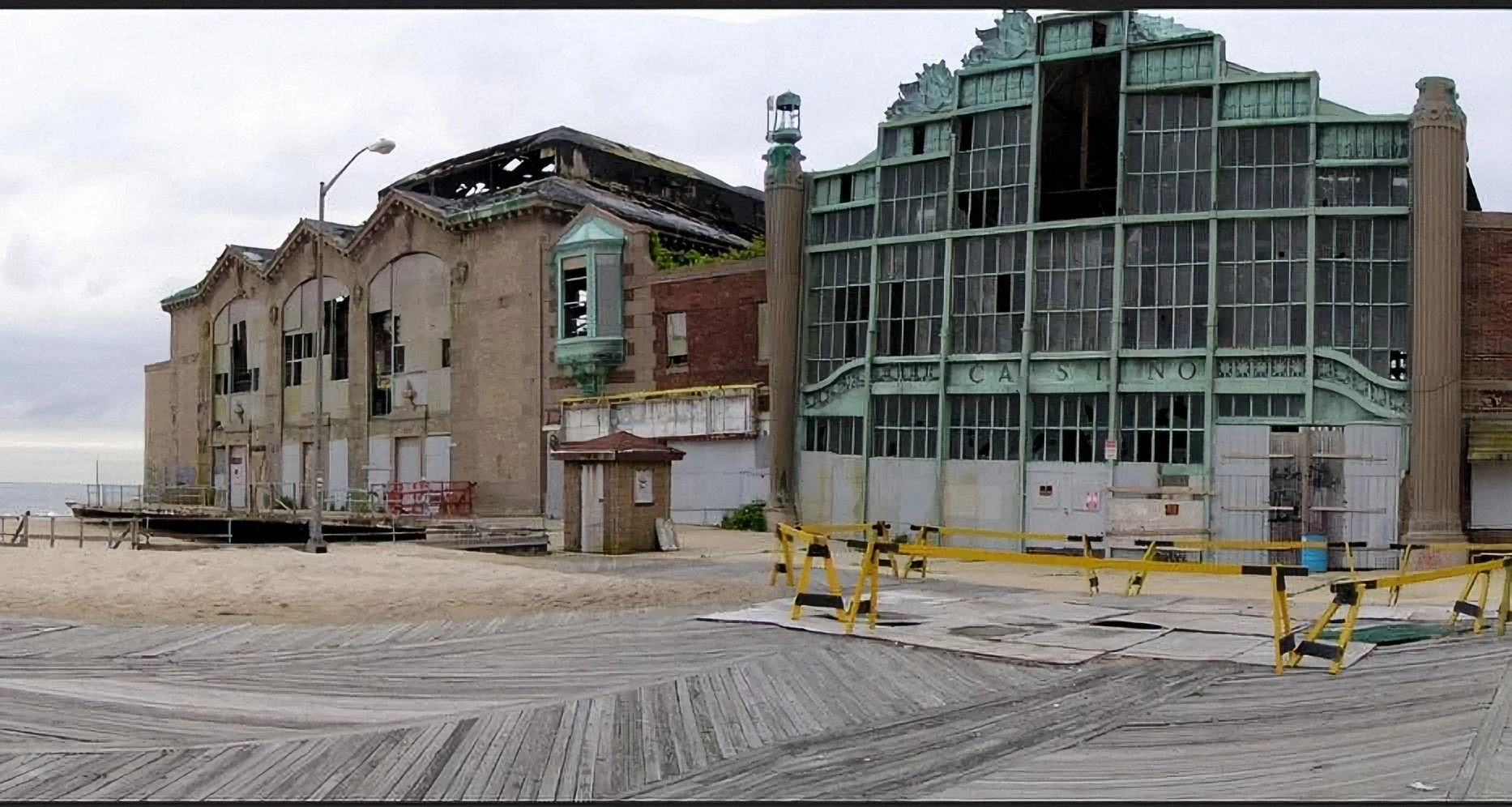
At the turn of the century, Asbury Park had long since fallen on hard times. Its “Dark City” nickname originated during the power outages of the 1960s, but now it seemed to fit the city’s economic fortunes.
Once a tourist destination and a local seaside favorite, the rise of interstates, giant theme parks, and mega malls made it too easy to pass by Asbury Park in favor of more attractive leisure options, especially once a series of race riots destroyed buildings, caused millions of dollars in damages, injured 180 people, and generated national press coverage.
When Palace Amusements closed in 1988 and the carousel was sold two years later, many took it as a symbol that Asbury Park was indeed now a city of ruins.
That changed after the turn of the 21st century, thanks to an influx of artists and musicians, a growing LGBTQ+ community, and a surge of real estate development that continues to this day.
Today, Asbury Park is once again a summer seaside destination, with both beach and boardwalk filled with throngs of locals and visitors alike. Once a remote incubator of the Jersey Shore Sound, Asbury is now a can’t-miss stop for major touring artists, one of the few small towns to attract big-name acts.
And at the very beginning of Asbury’s rebirth, there was Bruce Springsteen.
In December 2000, he held a pair of holiday concerts to benefit local food banks, youth and community organizations, and the Asbury Park Chamber of Commerce.
On the first night, following a star-studded main set full of rare treasures and fan favorites, Bruce returned to the stage for an encore. Before he played a note, he thanked the musicians who volunteered their time and talent, acknowledged the missions and contributions of the evening’s beneficiary organizations, and called attention to the redevelopment work that was just starting:
If you drive through Asbury today, you can see a lot going on. A lot of new businesses opening up… a lot of people refurbishing some of these beautiful old Victorian homes… There are some things happening!
And then he debuted the song he’d written for the occasion, performed alone on piano.
That original version of “My City of Ruins” is virtually identical to the song Bruce is playing on tour as I write this, despite some very minor lyrical changes.
And yet it’s completely different, written to mark the downturn of a seaside town and the first signs of a recovery.
More than any other song in his catalog, “My City of Ruins” is a chameleon. It takes on new meaning every time Bruce places it in a new context.
It brings new meaning each time, too.
It can be personal or political, local or universal, intimate or communal.
No matter the setting, however, and no matter the context, it invites listeners to grieve and then commands them to move forward.
All journeys start with a first step.
Rise up.
My City of Ruins
Recorded: February-March 2002
Released: The Rising (2002)
First performed: December 17, 2000
Last performed: May 30, 2026 (Philadelphia, PA)
© May 3, 2026