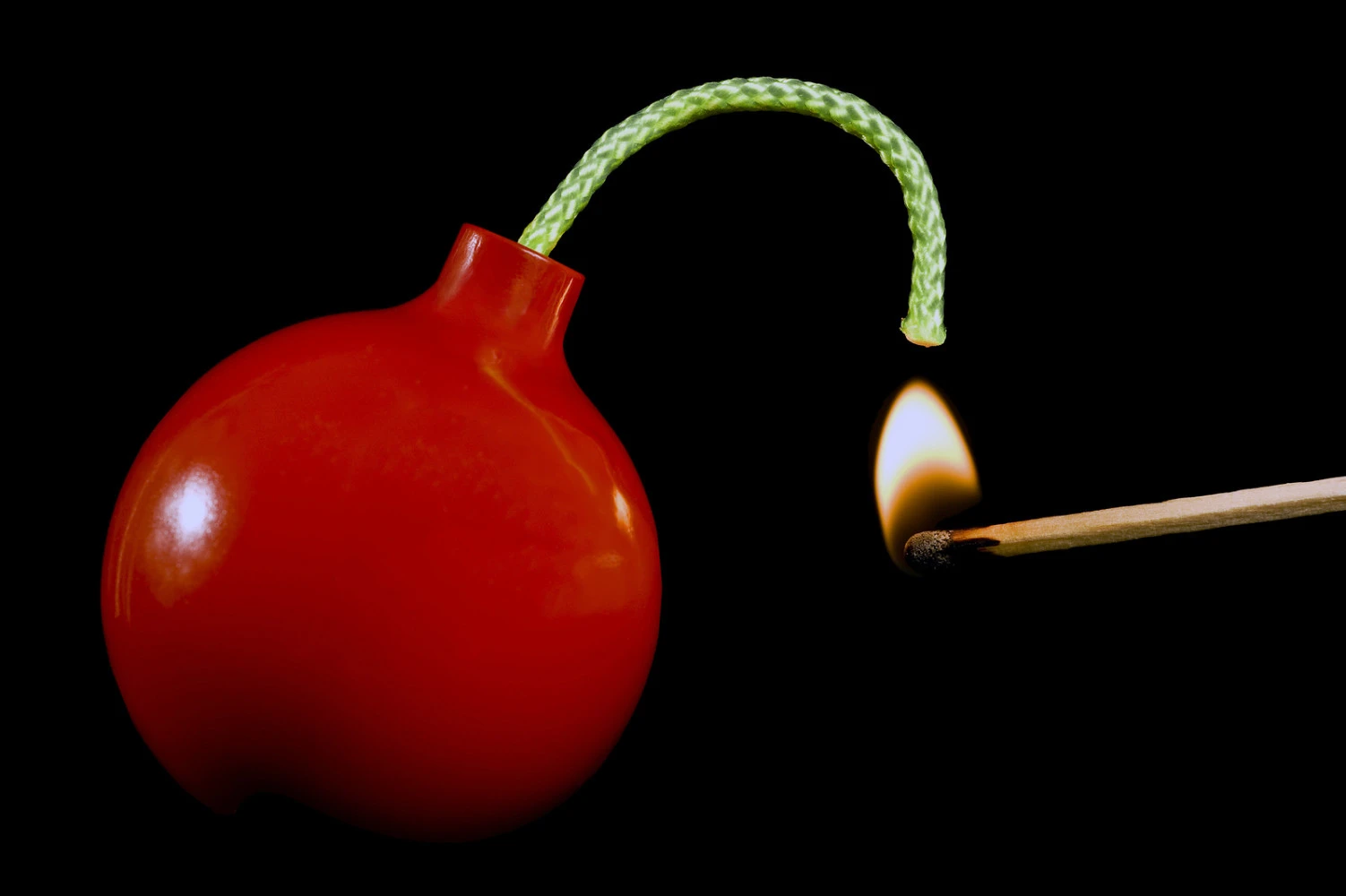
If there’s one song on The Rising that best captures the sense of collective dread gripping America in those first post-9/11 months, it’s “The Fuse.”
“The Fuse” tends to puzzle fans and reviewers, because on the surface it seems almost flip in its juxtaposition of tragedy and sex, and I suspect that with distance new listeners will understand it less and less. “The Fuse” is a you-had-to-be-there song.
Like many of Bruce’s best songs, “The Fuse” operates on two different levels: on the surface, it’s about our primal instinct to self-medicate trauma and tragedy–in this case, with physical connection. On a deeper level, though, “The Fuse” is about the last moments of normalcy before a tsunami of change sweeps over all that we know. This song is so remarkably prescient that we have to remind ourselves that it was written not years later but rather is one of the very first songs Bruce wrote after 9/11. Bruce knew what was coming long before it actually did.
The narrator of “The Fuse” is well aware of what’s coming, too–he can feel it, hear it, see it, even taste it. But it’s not here yet, and he’s determined to make the most of a fleeting moment, one last haven of time of out of time.
Let’s take a listen, and then we’ll break it down.
Before we get to the lyrics, let’s take a moment to appreciate the sonic landscape on display here.
This is one seriously dense song: Roy and Danny play no less than ten different keyboards, and Nils juggles four different stringed instruments. Add Steve’s mandolin, Bruce’s guitar and harmonica, Clarence’s sax, Garry’s bass, Soozie’s violin, and Max’s drums… there’s a lot going on, and it’s all in services of the song’s, um, climax. But we’ll get to that in a bit.
The key here is that in the first days, weeks, and months following 9/11, America was in turmoil–our collective mind screaming with grief, anger, fear, vengeance, distrust, need, paranoia–an emotional maelstrom that Bruce carefully recreates sonically.
There’s also a distinct color palette on display in “The Fuse” — the colors red and black are paired together recurringly throughout, symbolizing the rage and loss that were so predominant at the time.
Down at the court house they’re ringing the flag down Long black line of cars snaking slow through town Red sheets snapping on the line With this ring will you be mine The fuse is burning, shut out the lights The fuse is burning, come on let me do you right
The first verse sets the scene and the time: it’s very soon after the tragic events of September 11, 2001–early enough that flags are just starting to be lowered in honor of the dead, while mourners wind their way through the streets of town.
Here’s our first pairing of black and red: the cars of the funeral procession an obvious metaphor for loss, the snapping of the sheets a somewhat less-obvious metaphor for the winds beginning to gather into a storm.
And in the midst of grief and anger, there’s urgent life: a wedding proposal. Be mine. Be mine now, because there may not be a tomorrow.
The chorus of “The Fuse” can confuse if you hear the narrator callously dismissing the events of the day with a casual offer of sex. But those who can transport in an instant back to that place and time hear something different: a desperate need for connection, for life, for something good. The narrator knows that time is short–bad things are coming that will change the nation and the lives of its citizens–and that he can neither stop it or delay it.
But he can deny it, at least for now. He can offer his love the one power we all have at our disposal that can silence the rest of the world–intense physical connection. Bruce is keenly aware that sex done right is like a pause button on the world, a mute button on its cacophony, and this is the central conceit of “The Fuse.”
Trees on fire with the first fall’s frost Long black line in front of Holy Cross Blood moon rising in a sky of black dust Tell me baby who do you trust The fuse is burning, shut out the lights The fuse is burning, come on let me do you right
That first line of the second verse may be the best lyric in the entire song: “trees on fire with the first fall’s frost.” It works even when taken literally (because intense cold can feel like a burning sensation), but as metaphor it’s absolutely brilliant: we’re simultaneously numb and hyper-sensitive.
It’s also important that it’s the first frost of the fall–this another in a series of harbingers and omens that warn of something sinister coming our way.
And of course, we have another subtle red/black pairing (trees on fire/long black line of mourners), although this time the red is more figurative than literal. The blood moon against a sky of black dust is another–and the dust reference is important, too: Bruce doesn’t need it for imagery, but he includes it because it’s a reminder that we’re so soon after 9/11 that the remains of our lost loved ones are still floating in the atmosphere.
In many of Bruce’s songs, the bridge serves as the core of the song–the place where the song’s theme is distilled to its essence. “The Fuse” is no exception.
Tires on the highway hissing something’s coming You can feel the wires in the tree tops humming Devil’s on the horizon line Your kiss and I’m alive
We can summarize that bridge, indeed the entire song, thus: the best medicine for existential dread is the very act that makes us alive.
And that leads us into the last verse, which is entirely focused on that act:
A quiet afternoon, an empty house On the edge of the bed you slip off your blouse The room is burning with the noon sun Your bittersweet taste on my tongue The fuse is burning, shut out the lights The fuse is burning, come on let me do you right
Notice that as we enter that last verse, the cacophony has already diminished significantly–as the lovers succumb to each other’s seduction, the outside world has begun to drift away. We have one final red recurrence as the room is set ablaze by a sun that now represents a different kind of passion, but there’s no darkness in sight.
And oh, that last wonderful, brilliant line: your bittersweet taste on my tongue.
Yes, it’s a literal reference to cunnilingus, but the bittersweet reference also serves to remind both the narrator and the listener that we can’t ignore the outside world in full or for long. Bruce delivers the line as a coup de grace, vacuuming every instrument from the soundstage at the very moment of consummation–for a moment, we feel like we’re the only people in the world–just us and Bruce, whispering in our ear.
The band returns in full force a moment later, swirling around us for the remainder of the song, as if to remind us that the chaos of the world is still there. The backing track becomes increasingly dissonant and asynchronous as the song fades, a storm ominously gathering.
Before long, rights will vanish, wars will start, lives will be lost, and fear will rule the day. As Bruce reminds us over and over:
The fuse is burning.
Bruce played “The Fuse” regularly during the first couple of legs of the Rising Tour, but when the tour resumed in the late winter of 2003, he quickly began phasing it out. By the summer, it was all but gone, and in my opinion that was for the best.
“The Fuse” doesn’t translate well to the stage. The album track is carefully crafted and painstakingly layered; on stage, the band has far fewer instruments at their disposal, and even the best arenas couldn’t replicate the separation of the studio mix. What should be an eddy of musical voices is instead a drone. Watch the clip below from London in October 2002 and see what I mean.
I absolutely adore the studio version of “The Fuse,” but I never heard a live version that left me anything but lukewarm. Bruce wisely dropped “The Fuse” from his set lists after The Rising Tour, and it hasn’t been heard from since.
There is one final curiosity about “The Fuse,” however:
Not long after the song’s release, film director Spike Lee included it over the end credits of his remarkable film, 25th Hour. Debuting in December 2002, Lee’s film was one of the first and best movies to address life in a post-9/11 world, and “The Fuse” was a fitting song for it.
Strangely, though, while a fan of the song, Lee apparently wasn’t satisfied with the track as recorded:
I’ve always liked [Bruce’s] music. The co-producer of the film, John Kelly, grew up with Bruce in South Jersey. For years John has been tryin’ to drag me to see a Springsteen concert and I recently went to one on his last tour with The Rising. I bought the album, liked it a lot and I kept playing this song “The Fuse.” And then I got this idea, I said ‘Terence, why don’t we write a Sgt. Pepper-esque orchestral arrangement around this song that Bruce has done already. We do our scores in London, so we did it without telling Bruce. Bruce happened to be in Italy on tour so John went to Italy, played it for him and he said ‘That’s good, you can use it.’" (Spike Lee to Spence D, January 2003)
Terence is multiple-Grammy-winning composer and musician Terence Blanchard, who composed the score for 25th Hour. He also composed and arranged the “Sgt. Pepper-eseque” overlay, and it’s not particularly subtle.
At best, the overdubs are a curiosity, but as the song builds to its climax the additions mask the careful discordance of the original track and commit the unforgivable sin of undermining its final moments.
This alternate version of “The Fuse” has never seen an official release, even on the film’s soundtrack, which makes me wonder whether Bruce really gave it a close listen that day in Italy.
Perhaps Bruce thought better of it once he heard it in the film, because “The Fuse” as originally recorded is perfect.
The Fuse
Recorded February-March 2002
Released: The Rising (2002)
First performed: July 25, 2002 (Asbury Park, NJ)
Last performed: October 1, 2003 (New York City, NY)
Looking for your favorite Bruce song? Check our full index. New entries every week!
8 Replies to "Roll of the Dice: The Fuse"