8/31 UPDATE
After posting this on GreasyLake, I received a message from Pete Russell from Brucebase. He shared the below image of the Student Prince promotional material:
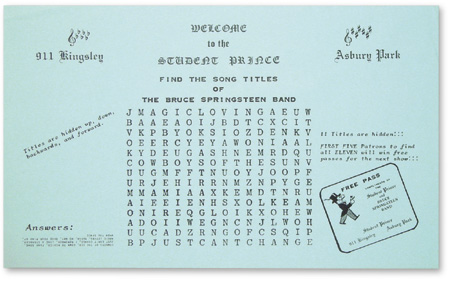
This was up til 2019 when Flickr deleted their account and caused all images on the site to be removed (an issue still being fixed today).
Intro
Back in January, I wrote a piece on Bob Weir after he passed on my blog. It was short, and focused primarily on the show I attended in June 2023. It was a different kind of writing for me, outside of my usual realm of update logs and project-related announcements.
Recently, I jotted down some ideas to explore writing about. Less to do with my projects but instead writing about other topics I’m interested in. Break things up a bit you know?
This idea was the first on that list, exploring the two very different versions of “Funk Song”. One by the Bruce Springsteen Band in the early 70s, and the other by the E Street Band in the summer of 1975. Despite sharing a name, they have very little in common. So much so that they could be considered different songs all together.
With that, lets get funky a little bit.
What is “Funk Song”
An instrumental jam from the “Bruce Springsteen Band” days, around late 1971 or so. Or at least that is the earliest possible reference to it I can find. Per Brucebase, it was mentioned in promotional material for a show at the Student Prince in Fall 1971 (which isn’t actually shown on the site, and I am unable to find it anywhere online.)
It is one of only a few true instrumental jams played by Bruce and the band, and the only to be repeated.
Despite the song dating to that period, and being notable enough to be mentioned in promo material, there are no verifiable performances of it. Very few setlists and even fewer recordings are known to exist from this era (publicly anyway). The earliest and only known recording of it comes from a band rehearsal in March of 1972, recorded at Challenger Surfboards in Highlands, NJ.
The “Funk” in Funk Song
The “Funk” in Funk Song refers to bassist Garry “Funky” Tallent, a nickname I wish stuck around to the band introduction days:
“His mother was a tallent, his father was a tallent, ladies and gentlemen Garry ‘Funky’ Tallent!”
“Funky” makes his debut and (to date) only lead vocal contribution to a Bruce song, saying “right on” several times during the rehearsal take.
An alternate title listed on Brucebase is “Funk Says Right On”, although every bootleg I can find of the 1972 rehearsal just lists “Funk Song”. The alternate title is pretty accurate, given that those are the only words spoken during the 6 minute rehearsal take.
8/31 UPDATE
After revisiting the 1972 Highlands rehearsal tape, I gave the “studio chatter” track a listen. This track proceeds Funk Song and contains the following spoken by Garry:
Funk Says Right On, take it or leave it
I had completely missed this on my listen for this writeup. Not thinking anything of the minute long chatter track. This gives us the “Funk Says Right On” title. “Funk Song” comes from the promotional crossword shown at the top of this page. How the Ubers arrived at “Funk Song” back in 2007 when the tape first circulated is currently unknown.
Back to the show.
Speaking of bootlegs, there are only 4 known recordings of Funk Song. The aforementioned band rehearsal from 1972, and a trio of appearances from the summer of 1975 when Bruce broke a string and the band had to kill time. However, for reasons I’ll get into later, the ‘72 and ‘75 versions of Funk Song are completely different songs.
Below I’ll cover each version in depth.
1972-03-14 - Highlands, NJ
Bootleg: Uber Series #26 Rehearsal Soundboard
Recorded at a band rehearsal on March 14th, 1972 at Challenger Eastern Surfboards in Highlands, NJ.
Bruce Springsteen - Lead Guitar?
Vini Lopez - Drums
David Sancious - Organ
Garry Tallent - Bass, Vocals
Steve Van Zandt - Rhythm Guitar?
Two guitar led, with Stevie on rhythm and Bruce on lead. I think Steve might’ve been on a Telecaster and Bruce on a Stratocaster or Mustang (going off pics from Back Door only a few weeks prior.) Bruce could’ve also been on a Les Paul. It is hard to tell which is playing which, though I believe this lineup is correct.
Starts with a building drum beat and organ and picked guitar from both. Drum builds and then we’re into the main song. The “structure” of the song is built around bars of Bruce/Stevie guitar riffing, with Bruce on lead and Stevie on rhythm. Steve plays mostly chords while Bruce riffs on top. 0:43 the organ comes in bringing us to a stop, with some Bruce riffs, organ build, riff again, another build and then a final break with Garry saying “Right On”.
The jam continues after this in a similar pattern. Very similar guitar based riffing from both Bruce and Steve. Garry plunking away on the bass. The organ break and guitar riffing happens again (1:43), very much the same, right down to the “right on” from Garry.
After this, the guitars take a backseat and David Sancious leads for a bit on organ. 2:11 someone yelps, not sure why. Guitars come back around 2:50, with the dual guitar riffing coming back in full force. Bruce going for faster fret work while Stevie keeps on chords. 3:50 Stevie throws some more riffs into the play, eventually developing a pattern of his own while Bruce keeps up the fast riffing. 4:30 the song breaks entirely and Bruce takes a solo, Vini keeping the beat on hi-hat and ride. 4:42 Garry comes in with a bass riff, weaving with Bruce’s guitar on this staccato thing. Drums come back 4:52, same for Stevie and the Organ. Song just keeps building with playing from all members, organ comes back 5:35 with the guitars building to a massive peak. 5:50 the song concludes with a final part from Bruce before the track ends.
Funk Song is very much what it says on the tin. A funky instrumental jam that doesn’t really go anywhere in particular. It sounds like a cross between the James Gang’ Funk #49 and Zeppelin’s Moby Dick. Due to it’s fairly simple structure, I could see live versions stretching pretty long, maybe with everyone taking a solo like how Kitty’s Back would become from 74 to 78. Shame there are no live versions in circulation from this era.
1975 Versions
Played 3 known times during the summer of 1975:
July 23 - Music Inn, Stockbridge, MA
July 28 - Carter Baron Amp., Washington, D.C.
August 8 - Civic Theatre, Akron, OH
There could likely be more, as there are still some unknown setlists and unrecorded/uncirculating shows from this time.
The band lineup during this era consisted of:
Bruce Springsteen: guitar
Clarence Clemons: sax, vocals
Roy Bittan: piano
Danny Federici: organ
Garry Tallent: bass
Stevie Van Zandt: guitar
Max Weinberg: drums
Despite sharing a name, these are basically different songs entirely. “Funk ‘72” is built upon repeated dual guitar riffing, and a heavier sound. “Funk ‘75” is lighter, with more of a piano and sax focus. “Funky” still plays a big part, with a plunking lead bass line throughout. It’s less “funk” and perhaps more “disco”. With the heavy presence of Clarence it is almost like a proto-“Paradise By The C”.
Funk Song made this brief return in 1975 as a time-filler while Bruce fixed a broken guitar string. These were the days before he had 5 backup Tele’s ready to go at a moments notice, and oftentimes he’d restring the guitar on stage while the band played around him. Thus the need for a “Bruce-less” instrumental jam.
The only thing tying the two versions together is C referencing Garry’s “right on” vocal bit during the D.C. version. At the very least, this confirms that the song was regularly performed, with Garry’s vocal being a big part of it. Otherwise, Clarence wouldn’t be bringing it up.
Below I’ll go over the three performances. They don’t differ a whole ton from one another, however each has their own aspects worth discussing.
1975-07-23 - Stockbridge, MA
Note: Show is commonly believed to have been in Lenox, MA. But actually takes place in nearby Stockbridge, just across city lines.
Bootleg: The Complete Lenox, The Complete Makeover (Fanatic Records Remaster)
The quality of this tape is very bass heavy and not great in terms of quality. It is also the longest of the trio coming in at about 9min.
Funk ‘75 is built heavily upon Garry’s insistent bass riff. With 3 bars of 6 and then a bar of 5, which then repeats throughout. The bass is the main driver of the song, with the rest taking a backseat.
However, it isn’t just a Garry song. Clarence and Roy both make big contributions to the song. Clarence ripping away on sax (hence why I called it a proto-“Paradise By The C”). Roy plays a piano part throughout that starts with the bass line but ends up weaving in and out of it. Max holds down the fort with a four-on-the-floor beat, a disco-ish hi-hat pattern, and snare hits on the 2 and 4.
1:50 gives us a short break with a different sounding section before returning the main hook. Almost like how the ‘72 version is built upon a main section with smaller sub-sections breaking up the action every now and then.
Around 3:20, Roy steps up with a faster piano playing for a bit. Max switches from the hi-hat to the ride at this point too, and around 5min adds in some crash hits to break up the beat a bit. This continues for a minute or so.
Notably absent during this is Bruce, who must’ve taken a long time restringing his guitar. Danny is also similarly absent, but this could just be him lost in the poor quality of this recording.
About 7min, Clarence switches from straight ripping to a more melodic sax part. Eventually finding a riff that complements the bass and piano parts.
8:40 the band brings it in for a final close, one last time around the bass riff, and Clarence hits one last long note to wrap it up. Interestingly, the song leads almost immediately into a 15min Kitty’s Back, as if a 9min instrumental jam wasn’t enough.
This Funk Song would become the template that the other two 1975 performances were based on. While it might seem like it was an improvised instrumental jam, it sounds too put together and composed for me to call it pure improv. Rather, I believe it could’ve been created during rehearsals/soundcheck around this time. But, much like the ‘72 version, it really doesn’t go anywhere. Sure, Roy’s piano part is interesting, and Max switches up the drum pattern a bit, the song doesn’t really change during it’s 9min runtime. It is a fun one time listen, but it isn’t really worth revisiting.
1975-07-28 - Washington D.C.
Bootleg: 2nd Gen Mono Audience Reel (Unknown Source)
The info file provided with this bootleg definitively links it to the 28th, however for a long time before it was believed to have been the July 29th show at the same venue. The info also mentions that the show was rain delayed for two hours, not starting until around 10pm.
This is the best sounding of the three versions from Summer 1975, with every member clearly audible. Unlike Lenox, the bass doesn’t drown out everyone else, but rather taking a back seat while still being prominent.
Unlike the previous performance happening because of a broken string, this one was due to Bruce’s guitar needing to be retuned due to the humidity in the air.
This one closely follows the example set by the Lenox performance. Plunking bass riff, disco drums, a great piano part, and a ripping sax part by Clarence. This is also the first time that Clarence mentions Garry’s vocal bit from the 72 version during it:
right on, right on. While Bruce is fixing his guitar we’re gonna get down a little bit, funky a little bit. I don’t know if you can dance, but if you can’t dance…[inaudible]
…as Garry would say: “right on”.
This one comment is all that associates the “75” version of Funk Song with the “Bruce Springsteen Band Funk Song. Without it, they’d be considered different songs entirely.
After the opening bass and drums, Clarence takes lead and drives the bus with a extended solo. This is the version that most closely calls to mind “Paradise By The C”, with the comparisons much more apt.
At 2:40, Bruce joins the party, interestingly enough on harmonica. Stevie makes his appearance with a nice lead guitar part. This part has Max switching to the ride cymbal but keeping the snare and kick parts the same. This section quickly starts building to a peak around 3:30, hitting it at 3:50 and descending into a calmer section.
The section around 4min switches control to Roy, with a nice melodic part that builds a bit with some fast playing. Bruce or Stevie join in with their own guitar riffing. Once again we build to a peak and release.
5:20 is the second appearance of the calm section. Clarence steps back up, with Max switching to a more traditional beat with some added snare hits. Much like the first section, Clarence takes an extended lead solo while the band builds behind him. Roy keeps his playing going.
At 6min, with Bruce’s guitar finally back in tune, he starts on some very pretty chords. Roy matches with some fancy pretty playing of his own. Max picks up the kick hits, building just a little bit, but this isn’t immediately picked up on by the others.
At 7min, Bruce returns to the chords for a bit. Clarence jumps over to what sounds like Baritone Sax for a spell. The fast notes and pretty playing from Roy comes back in. Bruce finds a nice riff and starts repeating it, with Roy joining him. It’s here (7:20) where the opening piano riff returns, signaling the end of the song.
Bruce continues with his riff for the rest of the song. 7:35 brings Clarence back in with his opening part. 7:48 sees Max drop the disco thing for a more driving beat, with more snare and kick hits. The song finally comes to a close after one last return to the disco feel from the opening and one last gasp from Clarence to bring us home.
I had intended this to be the shorter part, but this version just has so much to discuss. Musically it is much more interesting than the Lenox or 72 versions. Roy is more adventurous with his playing. Clarence is more confident with his lead part. The addition of Bruce on harmonica and him or Stevie on guitar really spices up the middle section. It still follows the same structure as the Lenox version, but with improvements to both the recording AND playing quality, it is a more enjoyable listen.
Despite only less than a week between the two performances, it developed a good bit in that short time. Perhaps they liked what they came up with and worked on it during soundcheck at either of the Kutztown shows in-between.
Regardless, the song would only make one more known appearance, which will be covered in the next section.
1975-08-08 - Akron, OH
Bootleg: Low Gen Tape Transfer (mjk5510)
Coming in at barely 4 and a half minutes, this is the shortest Funk Song by far. Continuing the existing pattern, it is played because Bruce has to fix his guitar (likely broken string).
Clarence is much more vocal during this version, encouraging the crowd to “get down”. And even introducing Roy and Stevie during their sections.
Of particular note is that this version features Stevie playing a similar part to Garry. Clarence still takes lead on the first section with a similar part to the 7/28 performance. Danny plays an organ part that wasn’t super noticeable on the earlier versions. 2:25 Garry gets a bump in the mix while Roy picks up his playing like the later sections of the 7/28 version. Clarence even introduces him during his part, before returning to his sax. At 3:25, “Miami” Stevie gets a section to lead for a bit. This version wraps up quite quick, with the ending coming at about 4min and finishing up not even 20 seconds later before (much like Lenox) going straight into Kitty’s Back.
This version doesn’t do much different from the others. Keeping to a very similar structure, although without the peaks and valleys that the D.C. version went through. I suppose Bruce got faster when it came to fixing his guitar, and this version was cut short.
This show would mark the last known version of Funk Song to date. While it is definitely possible that it made more appearances (there are quite a few unknown setlists), it is the last we have record of. The song was never tackled in the studio proper, and was likely forgotten about after this trio of performances.
What Became of It?
“Funk Song” disappeared around the same time that Bruce was preparing for the release of Born to Run. More songs from the (then upcoming) album were making their way into the show. And perhaps a close-to-ten-minute instrumental jam didn’t have a place anymore. Or Bruce just got better at not breaking strings, who’s to say?
Regardless, while “Funk Song” disappeared and was basically forgotten, the idea behind it wasn’t. The latter two versions of Funk Song heavily featured Clarence taking lead on sax. An idea that would reappear a few years later when “Paradise By The C” (a instrumental with Clarence taking lead) was regularly opening the second set on the Darkness tour. And while it might be bit of a stretch, you can find a similar sounding section on early versions of “Don’t Look Back” from the start of the Darkness sessions (available on The Unbroken Promise: Lighting Up The Darkness Sessions release by Godfather Records).
To date, Funk Song has never been officially released in any capacity. One song (Ballad of Jesse James) from that 1972 rehearsal tape was released on Chapter and Verse in 2016. Unfortunately, it is unlikely that any of the 1975 performances were professionally recorded (whether multitrack or soundboard). The Lenox performance was partially filmed by Barry Rebo, but that footage is likely to remain in the vault until the end of time. It is also unlikely that it was recorded in the studio, but again who’s to say?
Conclusion
In a way, one can view Funk Song as something of a “bridge”. One between his early bands, which were looser/jammier with a bigger focus on his guitar playing. And his later bands, which featured tighter ensemble playing.
In it’s short time in the live repertoire, it was a song that went from a loose jam to a composed instrumental. One that, at one point, was notable enough to promote the fledgling Bruce Springsteen Band. As well as eventually becoming nothing more than a time filler while Bruce replaced a broken string. For that reason, I find it interesting.
Funk Song remains one of Bruce’s only known instrumentals, one of only two to be played somewhat regularly in concert, and the only one to have not gotten a release yet.
Maybe on Tracks III…